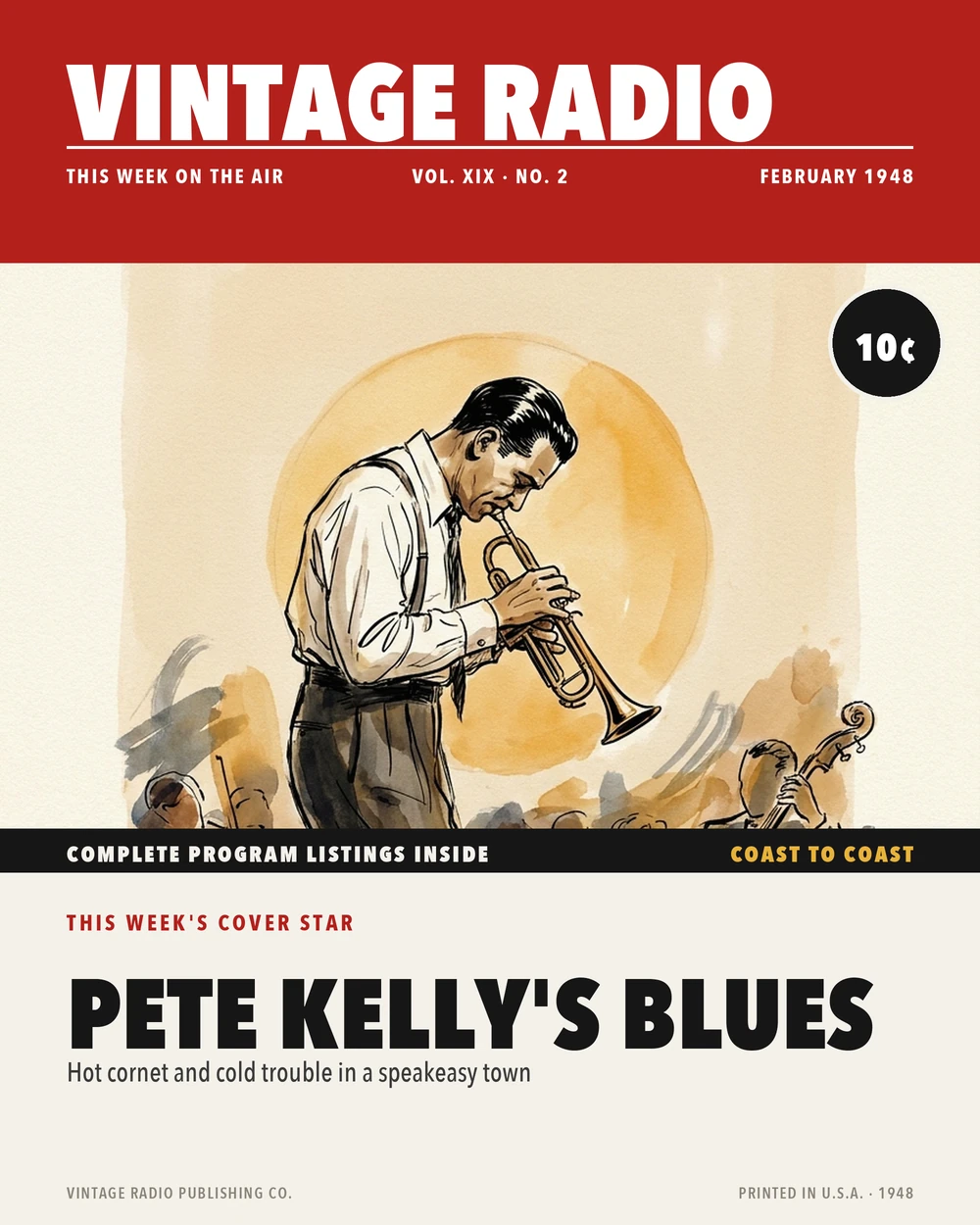
Pete Kelly's Blues
The Idea Behind the Show
Jack Webb was already one of radio's biggest names when Pete Kelly's Blues hit the air on July 4, 1951. Dragnet had turned him into a household name almost two years earlier, and NBC suddenly had a gap at Wednesday 8 PM — The Halls of Ivy had vacated the slot, and Dragnet's tobacco sponsors weren't going to fill it. Webb was asked to. What he brought was almost the opposite of Sergeant Friday: a cornet-playing jazz musician navigating Kansas City's speakeasy underworld in the mid-1920s, more wisecracking than stoic, more atmosphere than procedure. The show ran twelve weeks as an unsponsored summer replacement. Short as it was, it left a mark.
Creator Richard L. Breen and Webb went back a long way — they'd been roommates in San Francisco and had worked together on Pat Novak for Hire, the hard-boiled pre-Dragnet series that built Webb's radio reputation. That earlier show's influence is audible in Pete Kelly's Blues: the quips, the snappy comebacks, the short-tempered realism that Webb made his signature. Pete Kelly was a step back toward that pre-Dragnet style — looser, grittier, and with a sharp sense of humor Friday never had. The pilot was recorded on February 13, 1951, several months before NBC confirmed it as a summer replacement, which tells you Webb and Breen had been developing the concept on their own before they had a network slot to put it in.
The setting was deliberate and specific. Kelly's world was George Lupo's speakeasy at 417 Cherry Street — a smoke-filled Kansas City gin mill with flappers, sidemen, gangsters, and Prohibition agents wandering in and out every week. Lupo himself, the proprietor, was mentioned constantly on air but never actually heard, an offstage presence throughout the entire run. Maggie Jackson sang across the river at Fat Annie's, "on the Kansas side," which put her in a slightly different orbit from Kelly's Missouri-side joint. The stories were thin, but the atmosphere was something else entirely — Kansas City in the 1920s had been a real hotbed of both jazz and organized crime, and the series leaned hard on both.
The Music Was the Point
The jazz wasn't decoration. Each half-hour featured two full numbers by Pete Kelly's Big Seven plus a song by Maggie Jackson — three musical performances packed into a 30-minute crime show. Webb was a lifelong fan of hot jazz; he'd gotten his start in radio as a late-night disc jockey spinning jazz records in San Francisco, and he wasn't interested in generic studio music as a backdrop. He wanted authentic 1920s combo jazz, and he auditioned thirty musicians before settling on the band.
The Big Seven lineup was assembled with care. Dick Cathcart played cornet, Matty Matlock — who would later arrange the music for the 1955 film — played clarinet, and the rhythm section filled out behind them on trombone, piano, guitar, bass, and drums. Webb had known Cathcart from their time together in the Army. He later told Radio Life that their prior friendship wasn't why Cathcart got the job, and the thirty-musician audition process suggests he meant it.
George Fenneman opened each episode with the same line: "This one's about Pete Kelly," followed by the sound of a cornet dripping with blues. Fenneman, who served as announcer, had first shown Webb around when Webb was breaking into radio at KGO in San Francisco, and he'd continued working with Webb ever since, including on Pat Novak for Hire. The opening became a kind of signature, hooking listeners with the atmosphere before a word of dialogue was spoken. Capitol Records released a commercial recording from the series featuring the Big Seven with Meredith Howard as Maggie Jackson, including the song "Funny Man," which gives some sense of how the music was meant to stand on its own.
The Cast and the Writers
Webb played Pete Kelly, and the supporting cast was drawn almost entirely from Hollywood's Radio Row — the pool of West Coast character actors who made the radio scene work in those years. William Conrad, who was simultaneously playing Marshal Matt Dillon on Gunsmoke, turned up across multiple episodes as various mob bosses. Stacy Harris, Jack Kruschen, Whitfield Connor, Vic Perrin, Herb Butterfield, Peggy Webber, and Roy Glenn filled out the ensemble. Kruschen — who had previously played Sgt. Muggavan on Broadway Is My Beat — played Red, the combo's bassist, and the only regular band member with an ongoing speaking role, a detail that let the music and the drama share the same fictional space rather than running in parallel. A recurring character named Barney Ricketts, a boozy ex-bootlegger who served as an occasional informant, functioned much like Jocko Madigan on Pat Novak — Kelly's unreliable source of inside information on the criminal world he kept running into.
Meredith Howard played Maggie Jackson. Webb had known Howard since his days at Belmont High School, which makes her casting a piece of the same pattern visible throughout the credits — Webb building his production out of people he trusted and had worked with before. The announcer, the cornet player, the creator, the singer: almost all of them had prior Webb connections.
The writing came primarily from Jo Eisinger and James Moser, with Breen providing the concept and framework. Eisinger was serious talent — before Pete Kelly's Blues, he'd written the screenplays for Gilda (1946) and Night and the City (1950), two films that helped define what film noir could do, and he'd cut his radio teeth on The Adventures of Sam Spade. Moser had written for Dragnet and One Out of Seven. Between them, Eisinger and Moser wrote most of the show's thirteen scripts. The stories followed a consistent structure: Kelly runs afoul of a hood or mob boss and spends the half-hour working his way out of it, usually with a few well-placed one-liners along the way. Kelly's boss Lupo was described on air as "a fat, friendly little guy who wouldn't harm a fly — there's no money in harming flies," which gives a fair sense of the show's prose rhythm.
How It Translated to Film and Television
Pete Kelly's Blues ran concurrently with Dragnet during its twelve-week summer, making Webb one of the few radio performers simultaneously starring in two network series in the same season. When the summer replacement slot ended on September 19, 1951, the show was over on radio — but the world Webb and Breen had built wasn't done.
The 1955 film version, produced through Webb's Mark VII Ltd. and distributed by Warner Bros., was shot in CinemaScope and WarnerColor by cinematographer Harold Rosson. Breen wrote the screenplay. The cast included Janet Leigh, Edmond O'Brien, Lee Marvin, Andy Devine, Martin Milner, Jayne Mansfield as the club's cigarette girl, and Ella Fitzgerald in a cameo as Maggie Jackson, singing two numbers including the title tune. Peggy Lee played Rose Hopkins, an alcoholic jazz singer, and received an Academy Award nomination for Best Supporting Actress for the role; Film Daily named her the year's best supporting actress as well. Variety described the film as "a gangster picture (without the cops) with a Dixieland accompaniment," which captures the balance Webb was always trying to strike. Matty Matlock arranged the music, and three separate soundtrack albums were released due to different contractual arrangements, with the Fitzgerald and Lee versions appearing on Decca. Martin Scorsese reportedly followed the film from theater to theater in New York City as a teenager.
The NBC television series followed in 1959, running thirteen episodes from April 5 to September 4. Webb produced and directed under Mark VII Ltd., filmed at Republic Studios. William Reynolds played Pete Kelly this time, with Dick Cathcart again dubbing the cornet solos off-screen. Connee Boswell played Savannah Brown — the TV equivalent of Maggie Jackson — in ten of the thirteen episodes. Than Wyenn played George Lupo, finally giving a face and voice to the speakeasy owner who'd never been heard on-mic in the radio version. The TV series reused several radio scripts directly: the episode "The Poor Butterfly Story" was a remake of the radio episode "Zelda." Music from the TV series was released by Warner Bros. as Jack Webb Presents: Pete Kelly Lets His Hair Down, again featuring the Big Seven.
What Survived
Six of the thirteen radio episodes are known to survive as audio recordings, described by multiple sources as varying in quality. Among them are the July 4, 1951 premiere; "The Veda Brand Story" from July 11; "Little Jake" from July 25; "Zelda" from late August or early September; "June Gould"; and the series finale, "Dr. Jonathan Budd and the Dutchman," from September 19. The scripts for all thirteen episodes, including the pilot, were compiled and published by historian Martin Grams as Pete Kelly's Blues: The 'Lost' Radio Scripts, preserving the full text of episodes for which no recordings exist.
Bob Foster of the San Mateo Times called the show in 1951 "a powerful and direct answer to those who say radio is dead or dying" and "radio at its best." That response reflects something real about what Pete Kelly's Blues was doing — not using jazz as set dressing but making it central to what the show was. The twelve-week run is thin, and the surviving recordings don't give the full picture. But across the radio series, the 1955 film, two LP records, and a television series, Webb and Breen built something out of a Kansas City speakeasy that kept finding new audiences for nearly a decade.